WeChat

FlowBeijing

Expanding into international markets requires more than making a website available in different languages. Companies need to consider how their content is presented, how users navigate the website and how search engines understand and index its pages across different markets. Multilingual web design is essential to bringing these elements together, ensuring that a website is adapted to the needs of different audiences while providing a consistent user experience.
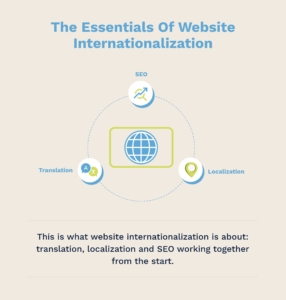
Each market has its own language preferences, search habits, digital platforms and technical requirements, and a successful international website needs to address these differences while keeping a consistent brand identity. This is what website internationalization is about: translation, localization and SEO working together from the start.
Below, we look at how to adapt your content, structure your website, help search engines show the right language version and avoid the most common mistakes.
Translation and Transcreation for Multilingual B2B Websites
When expanding into international markets, companies often make the mistake of treating website translation as a purely linguistic task. However, translating existing content word for word does not necessarily make it effective for a new audience.
Translation focuses on transferring the meaning of a text from one language to another while maintaining accuracy and consistency. It is particularly important for B2B companies working with technical products, industrial solutions or specialised services, where precise terminology is essential.
Transcreation goes a step further and adapts the original message to the cultural expectations, communication styles and preferences of the intended audience. The objective is to preserve the intended meaning and impact rather than the exact wording.
This distinction matters because business communication varies across markets. The way a European company presents its expertise, product advantages or corporate values may not resonate in the same way with Chinese business audiences.
Effective multilingual web development therefore combines accurate translation with cultural adaptation. Technical information must remain reliable, while marketing messages, headlines and calls to action should reflect the expectations of each market.
Keyword research is equally important. Search terms should be identified separately for each language rather than translated directly from the original website. Local search intent, industry terminology and the way potential customers describe their needs should guide content optimization.
The result should be a website that feels relevant and natural to local visitors, rather than simply a translated version of a website designed for another market.
How to Structure a Multilingual Website
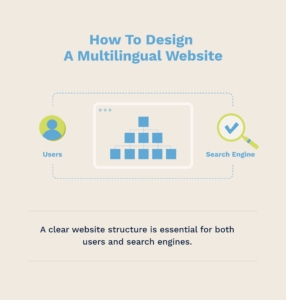
A clear website structure is essential for both users and search engines. When planning multilingual website development, businesses need to decide how different language versions will be organised and maintained.
There are three main approaches: country-specific domains, subdomains and subdirectories.
- Country-specific domains use a separate domain extension for each market, such as example.cn or example.de. This provides a clear geographical identity and supports local positioning, but each domain needs its own resources, hosting and SEO work, and authority is not shared between them.
- Subdomains place each language or market on a separate subdomain of the main domain, such as cn.example.com. This offers flexibility, particularly when markets require different technical configurations or hosting, although search engines may treat each subdomain as a distinct site.
- Subdirectories keep all language versions under the same domain, such as example.com/cn/. They are usually easier to manage, benefit from the authority of the main domain and allow a centralized website structure.
There is no universally best structure for every international business. The decision should depend on the company’s target markets, technical infrastructure, available resources and long-term expansion plans.
Beyond the technical architecture, a multilingual website should provide a consistent user experience. Visitors should be able to find the correct language version easily, for example through a visible language selector, navigate between pages and access relevant contact information.
It is also important to maintain consistency across translations. Navigation, page titles, metadata and internal links should be reviewed whenever a new language version is introduced.
A scalable structure makes future international expansion easier, reducing the complexity of managing content and technical SEO across multiple markets.
Once the language versions are in place, search engines need to understand how they relate to each other. This is where hreflang comes in.
Hreflang: How to Tell Search Engines Which Language Version to Show
One of the most important technical aspects of multilingual SEO is the correct implementation of hreflang tags.
Hreflang is an HTML attribute that helps Google understand the relationship between different language and regional versions of the same webpage. It indicates which version is intended for a particular language or geographical audience.
By providing this information, hreflang helps search engines identify the most appropriate version of a page to show users, providing clearer signals about the website’s international structure.
According to Google Search Central’s official documentation, there are several important principles to follow when implementing hreflang. First, language and regional codes must follow recognised international standards. Second, the different versions of a page should reference one another consistently. This reciprocal relationship allows search engines to verify that the pages are connected.
It is also important to ensure that the URLs included in the annotations are accessible and point to the correct pages. Incorrect references, missing return links or inconsistent implementation can prevent search engines from interpreting these language relationships correctly.
Hreflang should be considered part of a broader international SEO strategy, alongside localised content, the URL structures described above and appropriate indexing configuration.
Note that not every search engine relies on hreflang. Google and Yandex support it, while Baidu and Bing rely more on other signals, such as the page language declared in the HTML, the content itself and where the site is hosted.
What Each Search Engine Prioritizes: Google, Baidu, Bing, Naver and Yandex
A website internationalization strategy cannot rely exclusively on Google. Although it is the dominant search engine in many countries, other platforms play an important role in specific markets.
Each search engine has its own ecosystem, technical guidelines and approach to content discovery. Understanding these differences helps businesses adapt their websites to the markets they want to reach.
Google is the primary search engine for many international markets and rewards relevant, reliable and useful content.
For multilingual websites, it recommends distinct URLs for each language version rather than relying only on automatic language detection or redirection, together with correct hreflang implementation.
Translated pages should offer genuine value to local users, and their structure should allow Google to discover and index every version correctly.
Baidu
Baidu is China’s leading search engine and requires a market-specific approach.
Beyond translating a website into Simplified Chinese, companies should conduct keyword research in Chinese and pay attention to technical accessibility, since hosting location affects how fast the site loads for users in mainland China.
Websites hosted in China must also complete an ICP filing before going live. Hosting outside mainland China avoids this requirement but typically means slower loading speeds, so the right setup should be planned before the website is built.
Bing
Bing offers additional international visibility within Microsoft’s ecosystem. Its Webmaster Guidelines emphasise clear site architecture, crawlable internal links and accurate XML sitemaps.
For multilingual websites, each language version should be easy to discover, with well-structured pages and consistent metadata.
Naver
Naver is one of South Korea’s most important search platforms, and its ecosystem integrates blogs, knowledge platforms and shopping features.
Companies targeting South Korea should therefore consider how their content fits into this wider environment. Korean content should reflect local search behaviour, with accurate titles, relevant descriptions and a clear structure, as outlined in Naver’s Search Advisor guidelines.
Yandex
Yandex is a key search engine in Russia and has a significant presence in neighbouring markets such as Belarus and Kazakhstan.
For Russian-speaking audiences, professional localization and region-specific keyword research are the starting point. Yandex provides documentation on indexing localised pages, and its webmaster tools let businesses specify the geographic region of their website, helping communicate the intended audience.
In short, there is no single international SEO approach that works everywhere. The search engines, content formats and technical requirements relevant to each target market should influence the website strategy from the beginning.
Common Mistakes in Multilingual Website SEO
Even a well-designed and professionally translated website can struggle to achieve international visibility if its multilingual website SEO strategy is not adapted to local requirements.
One common mistake is relying entirely on automatic translation. Machine translation can speed up content production, but it may produce unnatural expressions, incorrect technical terminology or messages that do not reflect local communication habits.
Another is translating keywords directly from the original language. Search intent is not always identical across markets, and literal translations may not match the terms potential customers actually use. Keyword research should therefore be conducted separately for each target language and market.
Technical errors can also hold a website back. Incorrect hreflang implementation, broken links, duplicate pages and inconsistent canonical tags make it harder for search engines to understand which versions should be indexed.
Companies should also avoid focusing exclusively on Google. A website targeting China, for example, needs to consider Baidu and the specific requirements of its ecosystem.
Finally, international websites require ongoing maintenance. New products, services and corporate information should be updated across all language versions, since outdated translations create inconsistencies and reduce user confidence.
The most effective multilingual SEO strategies combine technical accuracy, locally relevant content and continuous optimization, rather than treating translation as a one-time activity.
Launch Checklist for Multilingual Websites
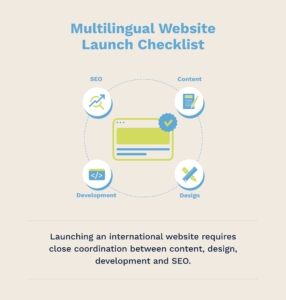
Launching an international website requires close coordination between content, design, development and SEO. Before going live in a new market, it is worth reviewing four key areas.
Content and localization
Translations should be reviewed by native-speaking professionals, and messaging and terminology adapted to local audiences. Keyword research should be completed separately for each market, and page titles, meta descriptions and calls to action localised accordingly.
Technical SEO
Before launch, make sure the following technical elements are in place:
- Consistent URL structure across all language versions
- Hreflang tags implemented correctly and reciprocally
- Canonical tags and XML sitemaps reviewed for every language
- All relevant pages crawlable and free of broken links or faulty redirects
Performance and user experience
Loading speed should be tested from the target market, and the layout and functionality checked on mobile devices. The language selector should be visible and easy to use, and forms, contact details and interactive elements should work in every version. Hosting and infrastructure must also meet local requirements, such as ICP filing for mainland China.
Search engine monitoring
Once the website is live, each language version should be monitored in the search engines relevant to its market. This means confirming that all pages are being indexed, tracking organic visibility by market and keeping translated content up to date over time.
International website development does not end at launch. Search behaviour, technical requirements and business priorities change over time, which makes continuous monitoring essential to maintaining visibility.
Frequently Asked Questions
How Can Flow Asia Help with Your Multilingual Website?
Expanding into international markets requires a combination of digital strategy, technical expertise and local market knowledge.
Flow Asia supports companies looking to strengthen their digital presence abroad, with particular expertise in China and cross-border digital projects. From website architecture and multilingual web design to localization, development and SEO, we help businesses create digital experiences that reflect their brand while meeting the expectations of different audiences.
Whether you need to introduce new language versions, improve an existing website or develop a digital platform for a new market, the process starts with understanding your objectives and the needs of your target audience.
Discover Flow Asia’s website internationalization services and learn how multilingual website development can support your international expansion.
How does Flow Asia approach multilingual web design for B2B companies?
Flow Asia combines website strategy, UX/UI design, development and localization to create websites adapted to different markets. The process takes into account the company’s brand positioning, target audiences, industry requirements and business objectives, ensuring consistency across all language versions.
Can Flow Asia translate and localise our website content, including for China?
Yes. With a dedicated Chinese team, Flow Asia delivers native-level localization for the Chinese market. This goes beyond translating existing pages, because content, terminology, messaging and user experience are adapted to how Chinese B2B audiences actually search, evaluate suppliers and make decisions.
How does Flow Asia make sure a multilingual website ranks on Google and Baidu?
Flow Asia addresses the technical and content requirements of each relevant search engine, from local keyword research and website architecture to metadata, indexing configuration and content optimization. For China, the strategy also covers Baidu’s requirements and the technical conditions of the local digital ecosystem, such as hosting and loading speed. SEO performance is then monitored and optimized over time rather than treated as a one-time setup.
Can Flow Asia update an existing website instead of building a new one?
Yes. A complete rebuild is not always necessary. Depending on the architecture and technical condition of the existing website, Flow Asia can improve its structure, add language versions, update the design, optimize performance and implement the necessary localization and SEO elements.
International growth starts with a website that speaks the language of its audience, both technically and culturally. With the right strategy, businesses can build a consistent digital presence while adapting to the needs of each market.
If you want to build a multilingual website that reaches the right audiences abroad, talk to our team. We’ll help you assess your current website, identify localization and SEO opportunities, and develop a strategy aligned with your international expansion goals.