WeChat

FlowBeijing
A website for the Chinese market requires more than simply adding a China page to your global site. China is one of the world’s largest and most complex digital markets, so your website has to look authoritative, comply with local requirements, and build credibility with Chinese audiences. Launching fast isn’t the point. You want a site that looks authoritative, loads fast, meets local compliance requirements, and reflects the premium standards expected in China. The process should therefore start with a clear vision. For a high-end brand, a template site is rarely enough. What works instead is a custom site that follows international design standards and matches your brand. Here, you can learn more about our website design and development services in China.
Begin with a strategy, not just a translated website
Leading international brands in China follow an ‘In China, for China’ approach. Simply translating your existing site isn’t enough. Your content should address local needs, show who you work with, and demonstrate your long-term commitment to the market. Your visitors include corporate and government decision-makers, international partners who want to see that you’re both a global name and committed locally, and candidates who judge employers by their websites. A B2B site in China needs to be clear and direct. You are not speaking to casual shoppers. Your audience wants stability, proof, and easy access to information.
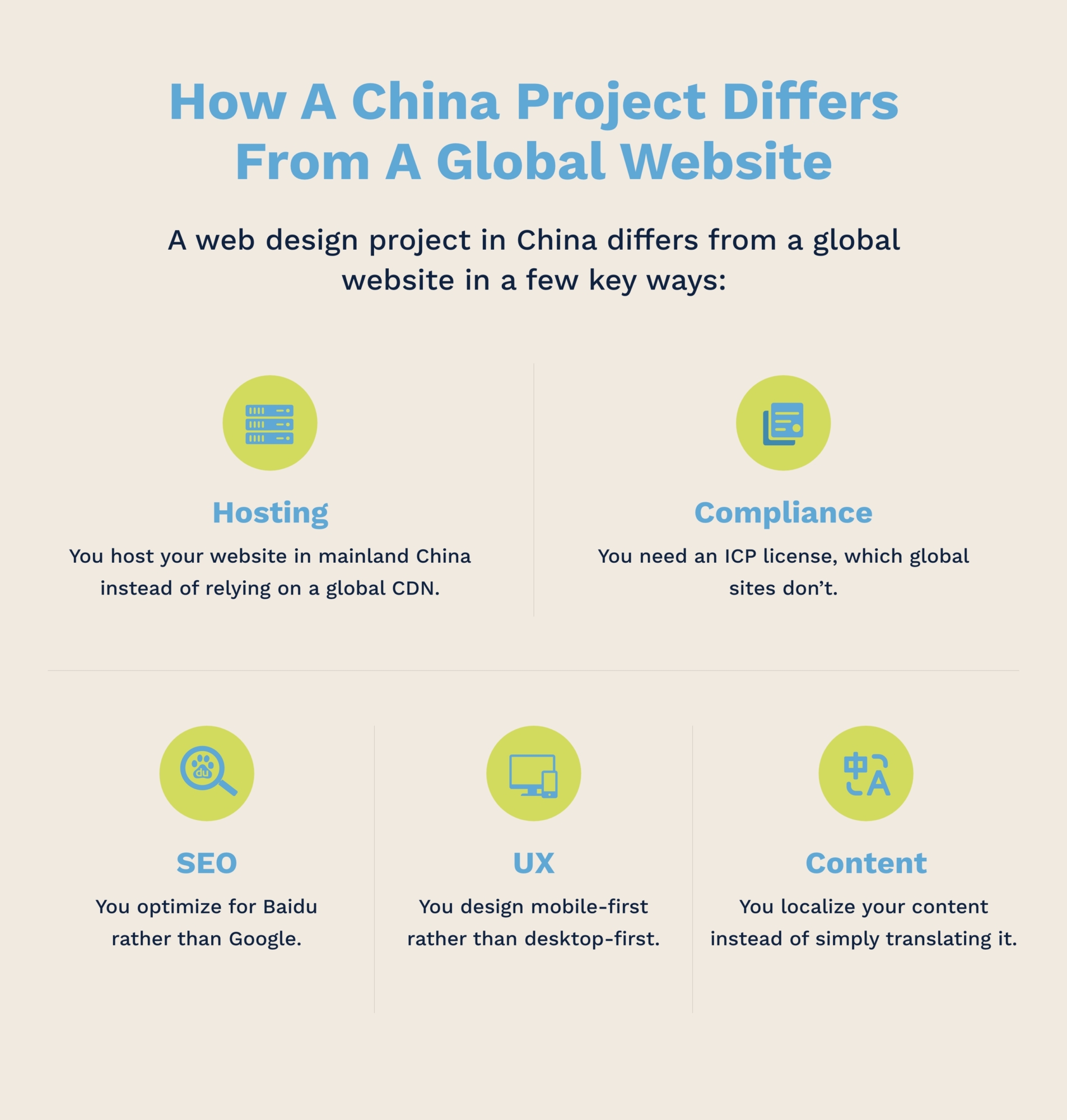
How a China Project Differs from a Global Website
A web design project in China differs from a global website in a few key ways:
- Hosting. You host your website in mainland China instead of relying on a global CDN.
- Compliance. You need an ICP license, which global sites don’t.
- SEO. You optimize for Baidu rather than Google.
- UX. You design mobile-first rather than desktop-first.
- Content. You localize your content instead of simply translating it.
How to Choose a Web Design Agency in China
Choosing the right partner matters a lot for a web design project in China. International brands usually choose from three types of agency:
- Local Chinese agencies
- Global agencies with no China experience
- China-focused full-service agencies
A specialist agency with experience in China can handle compliance, localization, and SEO, while also helping the site grow over time.
The Technical Setup Behind a China Website
Every project in China starts with the basics. First, you need to apply for an ICP license through the Ministry of Industry and Information Technology; otherwise, your site cannot be legally hosted in mainland China. A good local partner will handle this process for you. You should also host the site in mainland China for better performance, as Chinese users expect pages to load in under two seconds. Local cloud providers such as Alibaba Cloud, Tencent Cloud, or AWS China work well, and if you have international teams, a global CDN can help keep access fast worldwide.
Mobile matters most of all. According to CNNIC, 99.7% of Chinese internet users go online via mobile, so your B2B content should be designed with a mobile-first approach. Spec sheets and inquiry forms must work seamlessly on mobile devices. These development choices have a direct impact on how many visitors actually convert. For premium projects, full source code delivery is a must. Look for a vendor that provides the unencrypted source code and deploys the site locally. This prevents vendor lock-in and makes the website easier to maintain in the long term. Remember that these technical choices directly affect both performance and search visibility in China.
Content Localization and Compliance in China
For China, content should always be written in Simplified Chinese only. Traditional Chinese is used in Hong Kong, Macau, and Taiwan. Have your copy written by native speakers who understand your industry rather than relying on machine translation. Compliance matters here too, as China’s advertising laws are strict. Wording that is acceptable in the US or Europe can result in your site being blocked or fined in China. Avoid absolute claims, promises you cannot substantiate, and phrases such as ‘most popular’ or time-limited guarantees. Describe what your product actually does and keep the tone measured and credible. Many Chinese teams use ‘transcreation’, which means adapting the message to local expectations while preserving the original meaning.
On a B2B website in China, trust-building content matters as much as your product pages. Buyers here want proof before getting in touch. It helps to include:
- local case studies with well-known partners
- downloadable technical documentation and white papers
- clear local contact details, including a local address and phone number
- certifications such as ISO or CCC, where relevant
- executive bios and team introductions, which make the company feel more human
This is the kind of work we do. You can take a look at our website localization solutions for China here.
Visual and UX standards in China
Premium websites in China follow a ‘less is more’ approach. The goal isn’t to look flashy, but to convey a sense of quality and trust. The standard look is minimalist, with a palette of two or three muted main colors and custom photography. Stock photos can make your brand look less credible. Keep the typography clean and controlled, with sans-serif fonts and careful attention to spacing.
Premium brands rely on visuals to tell a story and connect with visitors. Full-screen visuals, scenes that show products in real business settings, and smooth micro-interactions can make a site feel modern and engaging.
Conversion design in China works differently from in other markets. Teams use what are known as invisible conversion paths. CTAs blend into the design, inquiry buttons are placed where users naturally look, and forms are short and simple. This allows you to generate inquiries without making the page feel like a sales pitch.
Baidu SEO, GEO, and AEO
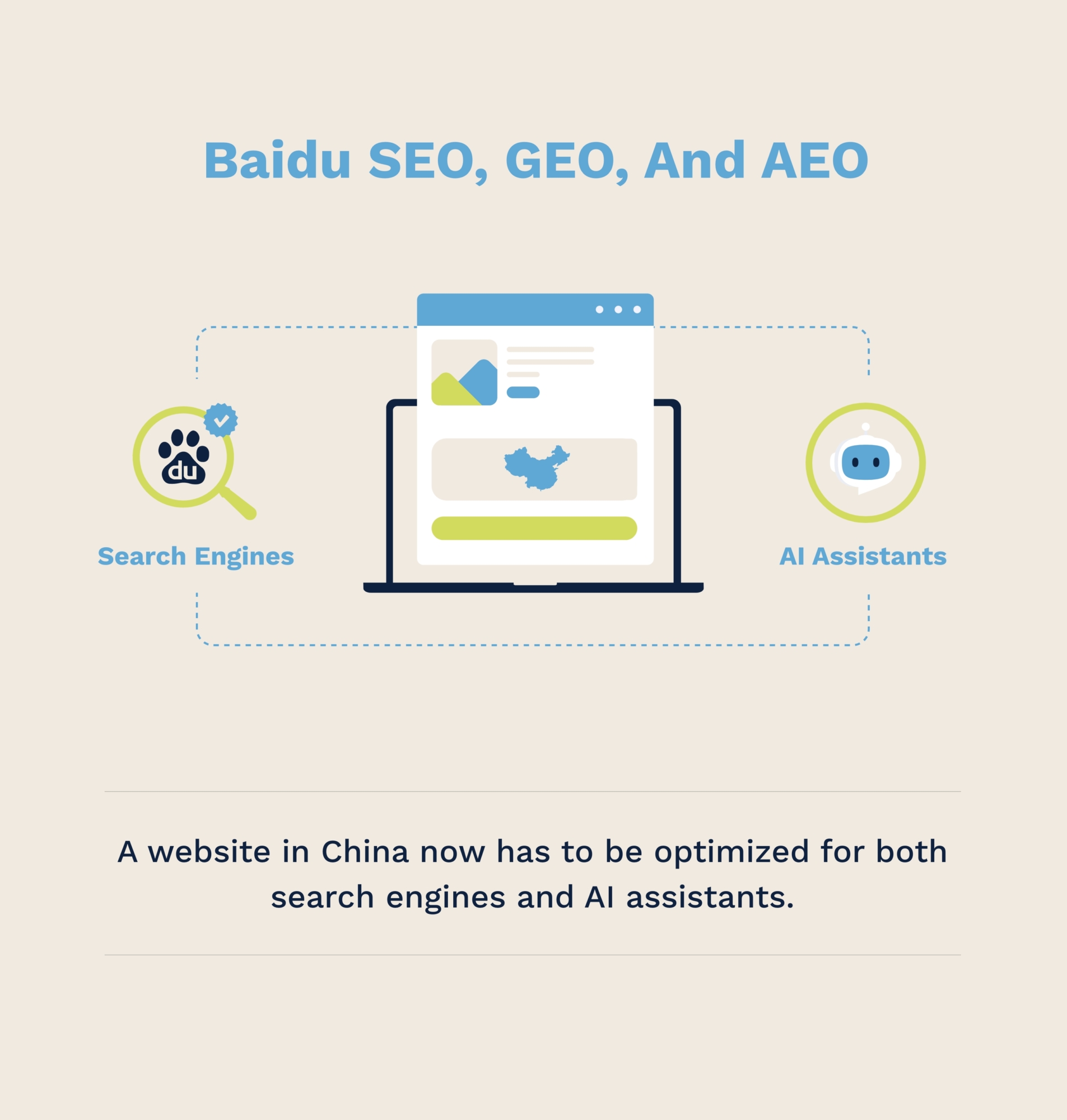
A website in China now has to be optimized for both search engines and AI assistants. According to StatCounter, Baidu holds around half of China’s search market across all devices, and close to 80% on mobile.
Baidu does not work like Google. It relies heavily on its own keyword research ecosystem, so it’s important to use Baidu’s keyword tools to understand how users in China actually search for products and services like yours. Unlike Google, meta keywords still play a role in Baidu’s indexing. In addition, Baidu places strong emphasis on freshness: frequently updated content is seen as a signal of credibility and relevance. Local hosting can also improve crawl frequency, while mobile performance remains one of the most important ranking factors.
Search is changing with AI assistants such as Tencent Yuanbao and Baidu AI. Teams now focus on GEO (Generative Engine Optimization) and AEO (Answer Engine Optimization). In practice, that means creating content that answers real industry questions, keeping the language clear and accurate, and adding structured data so AI systems can find and quote it. It also helps to provide search engines and AI tools with clear, well-organized information about your brand and industry. All of this is part of our SEO services for China.
Multi-language Strategy When China is your Asia Hub
If your China website will support business across the Asia-Pacific region, it should support multiple languages from the start. The best vendors offer 25 or more languages, each on its own subdomain or URL path, and use hreflang tags to ensure the right language version is displayed for each region.
Each version shouldn’t simply be translated but properly localized, with the appropriate units and currencies. Speed matters too, so set up regional hubs, such as Singapore for Southeast Asia and Germany for Europe, to keep access fast worldwide.
Launch, Improve, and Treat the Site as a Long-Term Asset
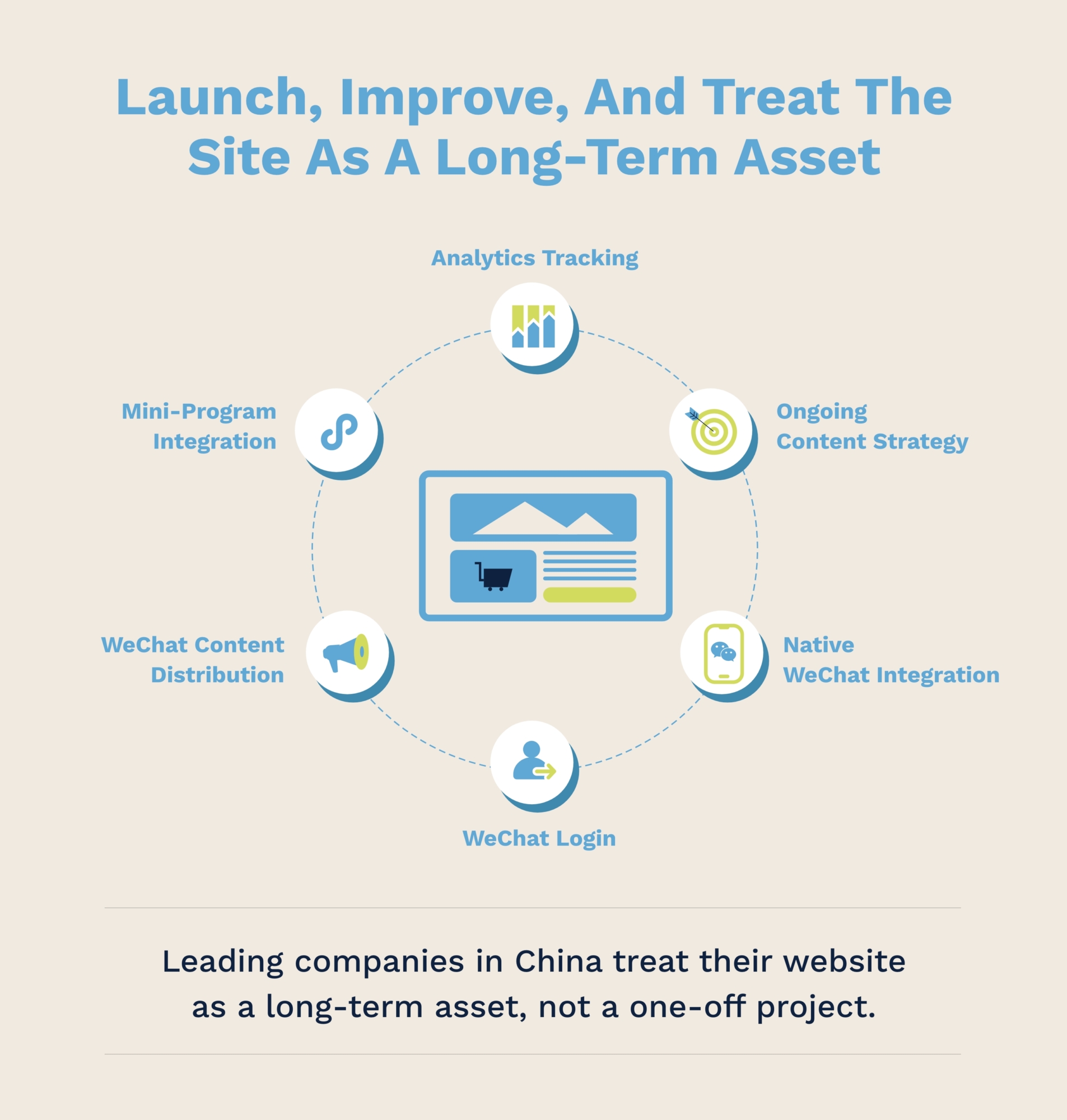
Leading companies in China treat their website as a long-term asset, not a one-off project. Key best practices include:
- Add analytics from day one to track heatmaps, conversion paths, drop-off points, search queries, and traffic by language
- Build a continuous content strategy with regular updates, including new case studies, product releases, and event recaps from across China
- Integrate WeChat from the start, including visible QR codes and follow buttons on key pages
- Enable WeChat login for member areas when relevant to reduce friction for users
- Distribute content through your WeChat Official Account to extend reach and engagement
- Connect Mini Programs for bookings, inquiries, and customer service to streamline user journeys
A well-executed approach can deliver measurable results. For example, a listed new energy company rebuilt its site as a lead-generation platform (获客型官网), strengthened its visual branding, and expanded traffic across multiple channels. Within six months, it achieved a 215% increase in leads, an 80% improvement in conversion rates, and a 42% reduction in customer acquisition costs.
Common Questions About Web Design in China
How much does web design in China cost?
Costs depend on the project’s complexity, level of localization, and hosting setup. B2B websites typically require custom development.
Do I need an ICP license?
Yes. Without one, your website cannot be legally hosted in mainland China.
Should I host my website in China?
For better performance and SEO, local hosting is recommended.
Is Baidu SEO different from Google SEO?
Yes. Baidu places greater emphasis on local infrastructure, Simplified Chinese content, and different ranking factors.
Choosing a service partner in China
Not all agencies in China are the same. Full-service firms like Flow work with demanding clients and high standards, covering brand identity, design, development, SEO, GEO, and post-launch support, as well as storytelling and content. For most international brands in China, a full-service firm is the safest choice, as it can handle the complexity and take responsibility for the entire project.
A good web design project in China brings together strategy, compliance, performance, and credibility. For international B2B brands, a website in China isn’t a one-off project. It’s a long-term asset that supports your visibility, builds trust, and generates leads in China. If you’re planning a website for the Chinese market, talk to Flow Asia about your project.