WeChat

FlowBeijing
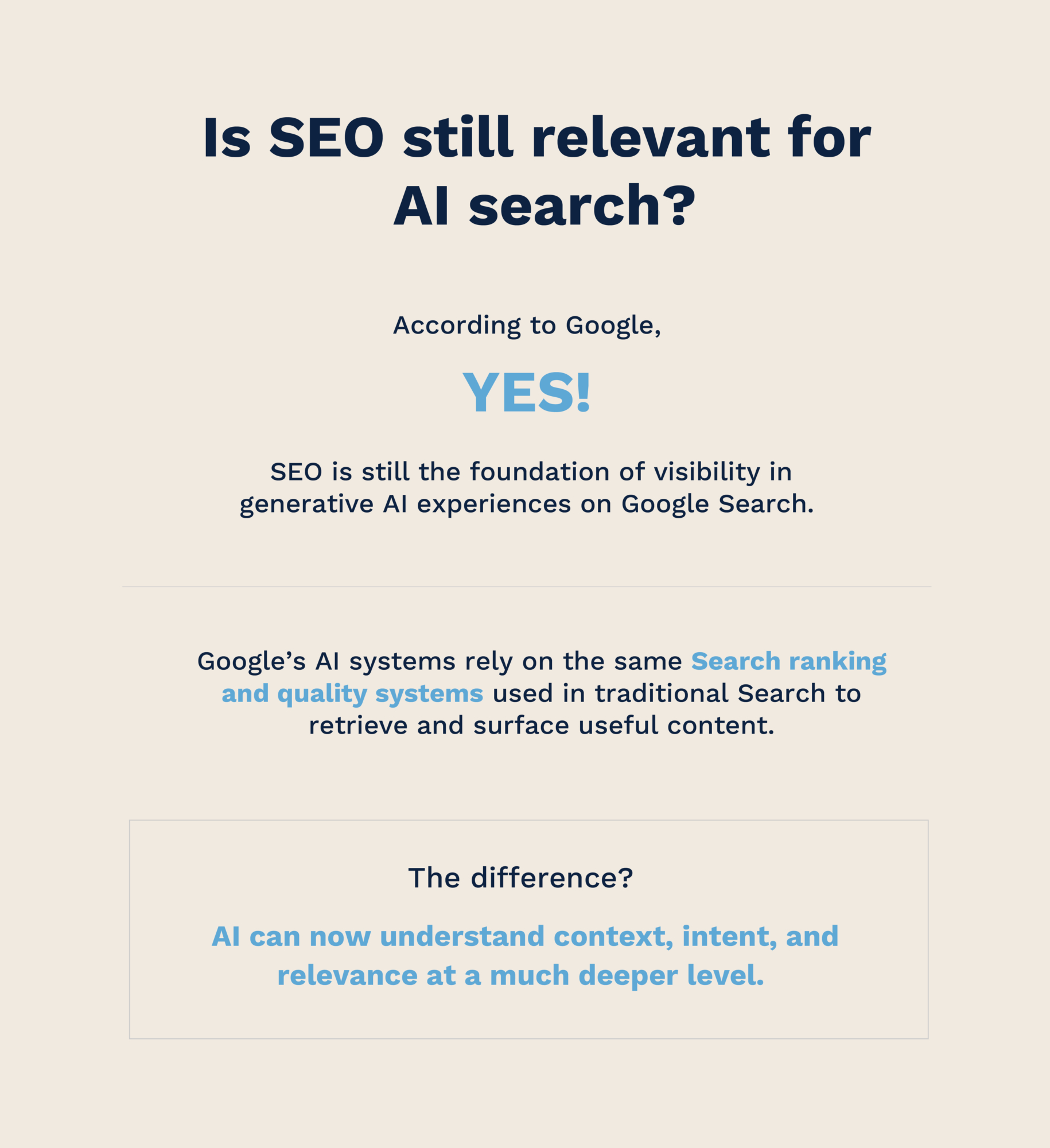
Is SEO still relevant for AI search?
According to Google, YES! SEO is still the foundation of visibility in generative AI experiences on Google Search.
Google’s AI systems rely on the same Search ranking and quality systems used in traditional Search to retrieve and surface useful content.
The difference? AI can now understand context, intent, and relevance at a much deeper level.
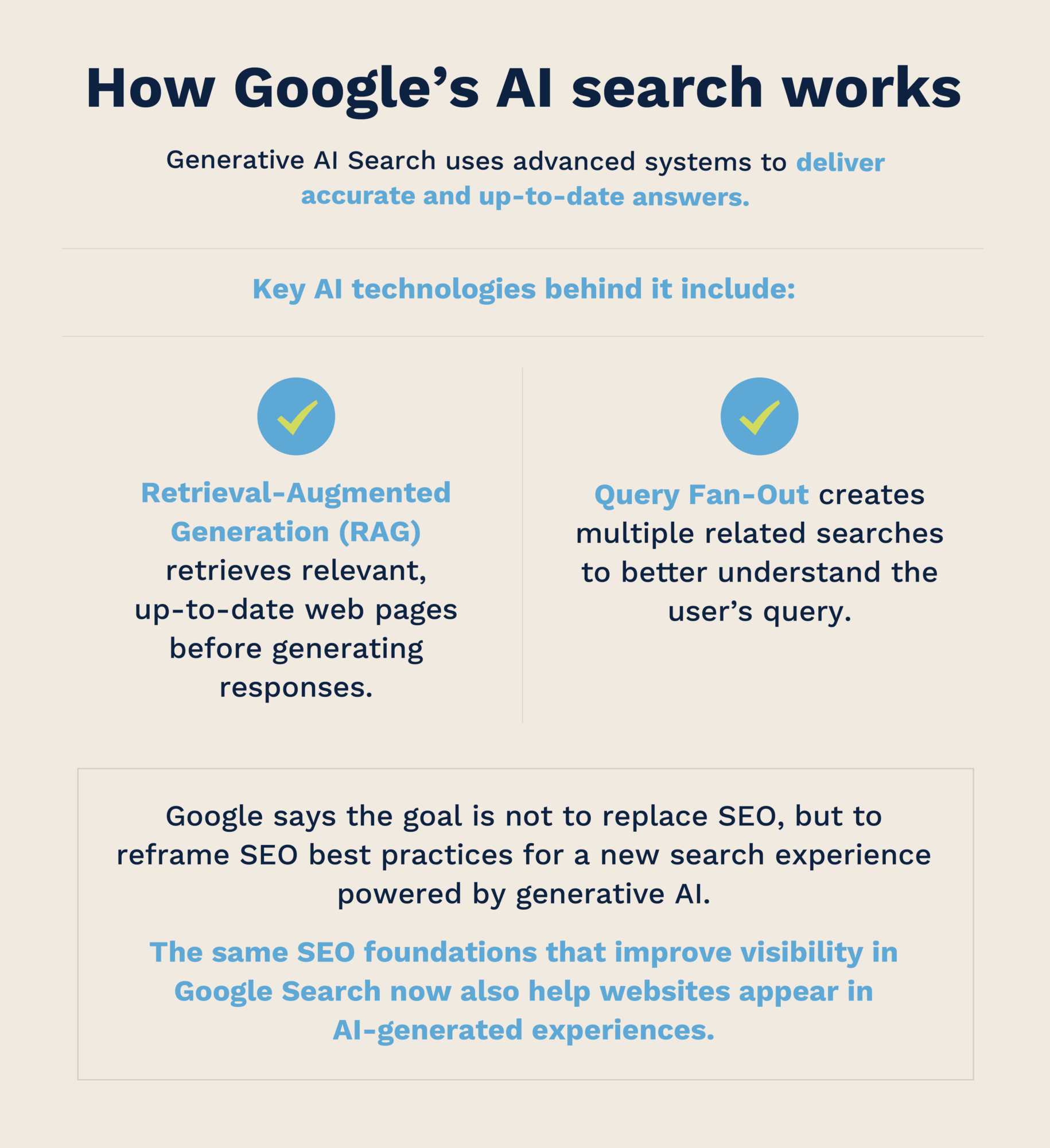
How Google’s AI search works
Generative AI Search uses advanced systems to deliver accurate and up-to-date answers.
Key AI technologies behind it include:
- Retrieval-Augmented Generation (RAG) retrieves relevant, up-to-date web pages before generating responses
- Query Fan-Out creates multiple related searches to better understand the user’s query
Google says the goal is not to replace SEO, but to reframe SEO best practices for a new search experience powered by generative AI.
The same SEO foundations that improve visibility in Google Search now also help websites appear in AI-generated experiences.
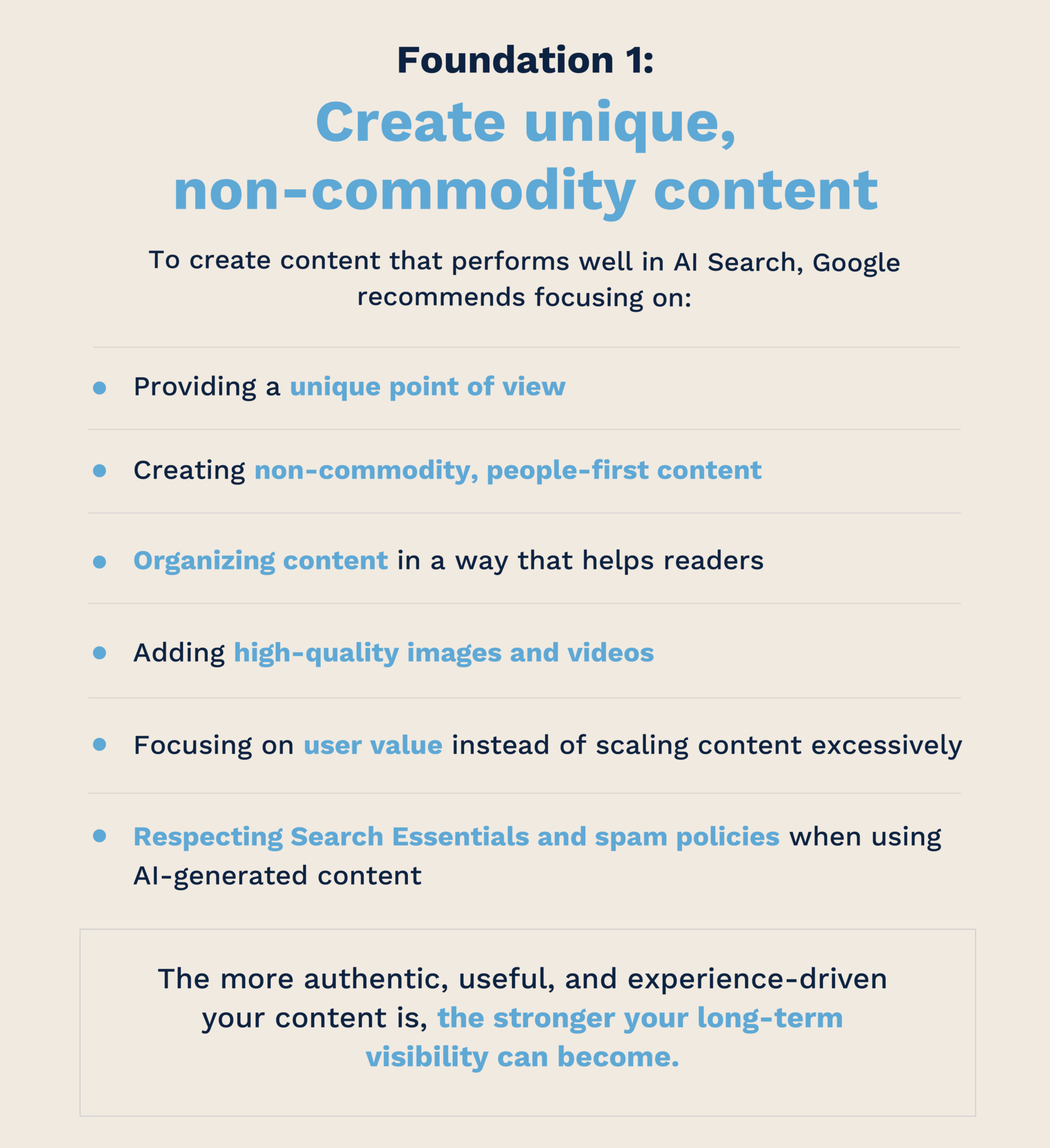
Foundation 1:
Create unique, non-commodity content
To create content that performs well in AI Search, Google recommends focusing on:
- Providing a unique point of view
- Creating non-commodity, people-first content
- Organizing content in a way that helps readers
- Adding high-quality images and videos
- Focusing on user value instead of scaling content excessively
- Respecting Search Essentials and spam policies when using AI-generated content
The more authentic, useful, and experience-driven your content is, the stronger your long-term visibility can become.
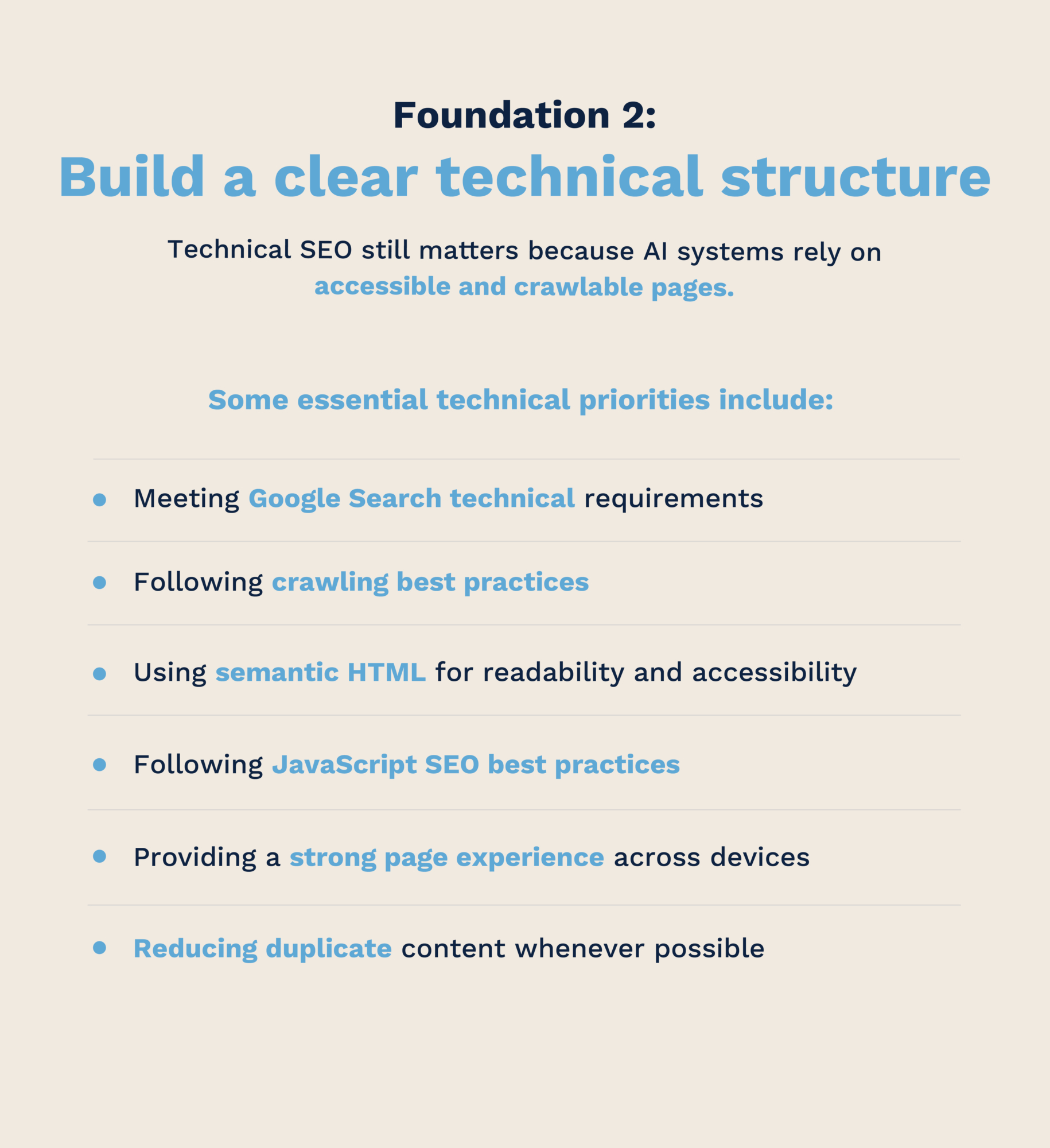
Foundation 2:
Build a clear technical structure
Technical SEO still matters because AI systems rely on accessible and crawlable pages.
Some essential technical priorities include:
- Meeting Google Search technical requirements
- Following crawling best practices
- Using semantic HTML for readability and accessibility
- Following JavaScript SEO best practices
- Providing a strong page experience across devices
- Reducing duplicate content whenever possible
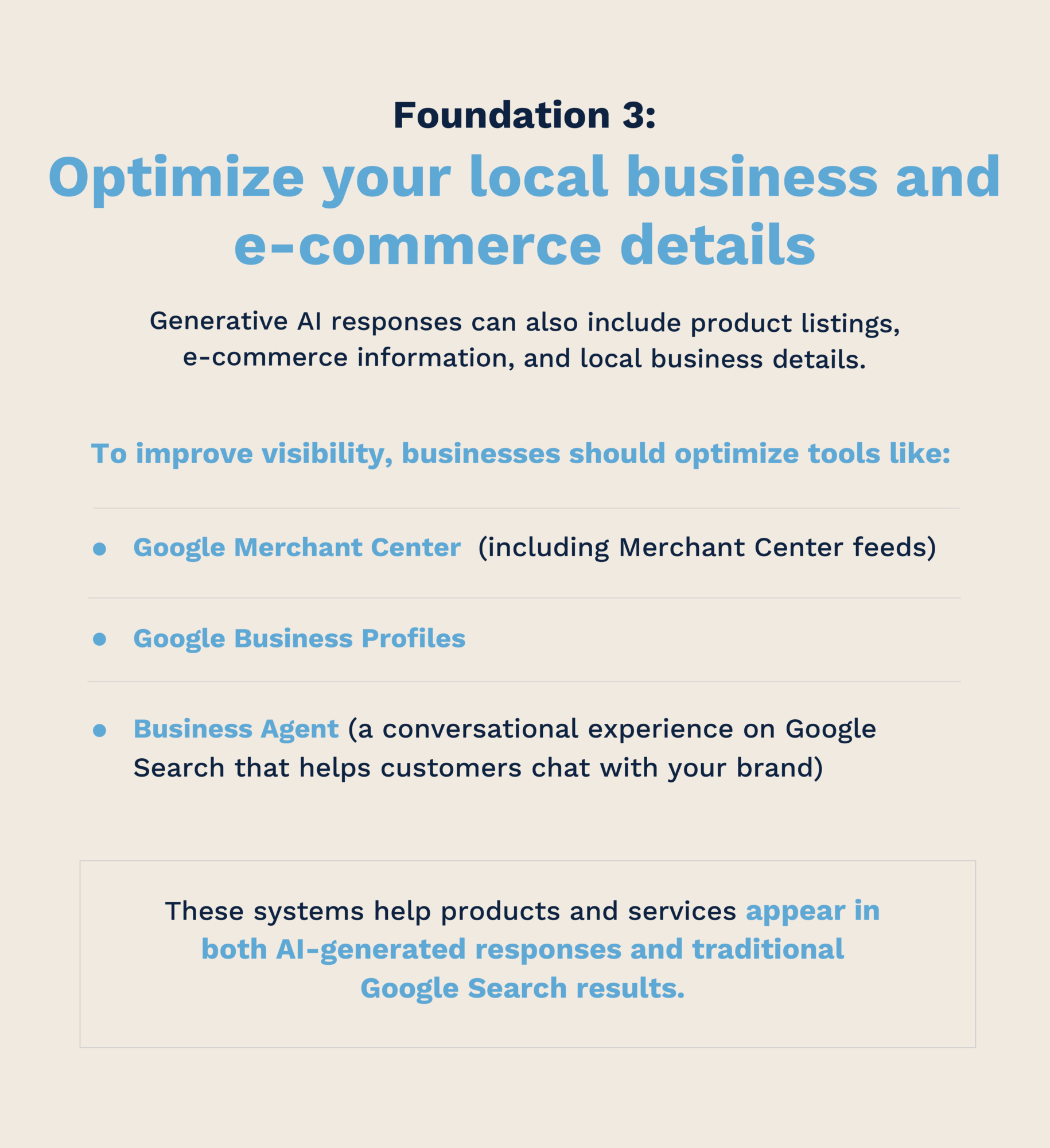
Foundation 3:
Optimize your local business and ecommerce details
Generative AI responses can also include product listings, ecommerce information, and local business details.
To improve visibility, businesses should optimize tools like:
- Google Merchant Center (including Merchant Center feeds)
- Google Business Profiles
- Business Agent (conversational experience on Google Search that helps customers chat with your brand)
These systems help products and services appear in both AI-generated responses and traditional Google Search results.
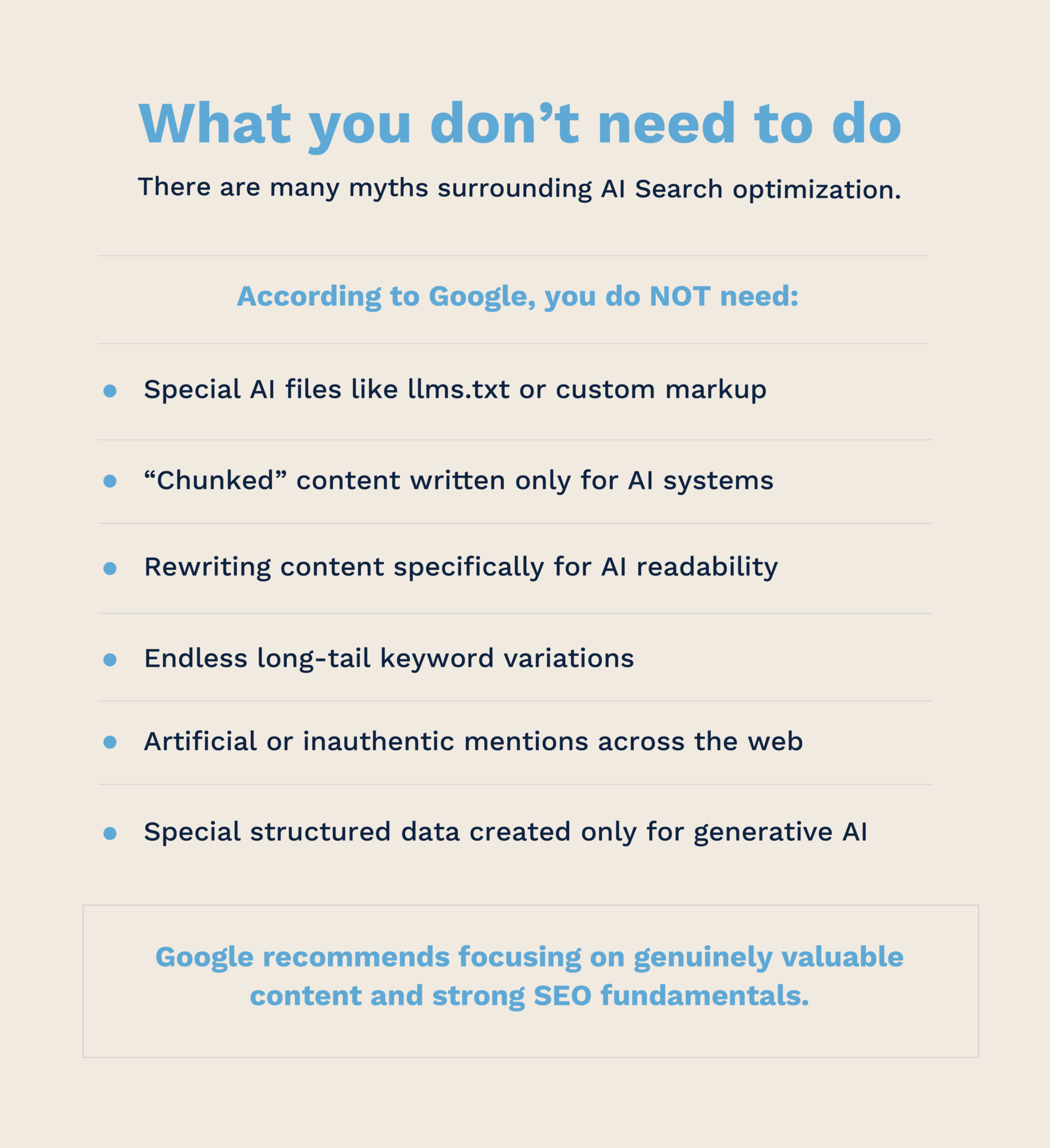
What you don’t need to do
There are many myths surrounding AI Search optimization.
According to Google, you do NOT need:
- Special AI files like llms.txt or custom markup
- “Chunked” content written only for AI systems
- Rewriting content specifically for AI readability
- Endless long-tail keyword variations
- Artificial or inauthentic mentions across the web
- Special structured data created only for generative AI
Google recommends focusing on genuinely valuable content and strong SEO fundamentals.
Explore the future of agentic experiences
Google is beginning to explore AI agents that can perform actions on behalf of users, such as booking reservations or comparing products automatically.
These systems may analyze screenshots, website structures, and accessibility elements to complete tasks directly inside Search experiences.
Staying informed about emerging agent-friendly experiences and protocols such as Universal Commerce Protocol (UCP) will become increasingly important.
As AI agents evolve, websites with stronger accessibility, structure, and usability will gain a significant advantage.
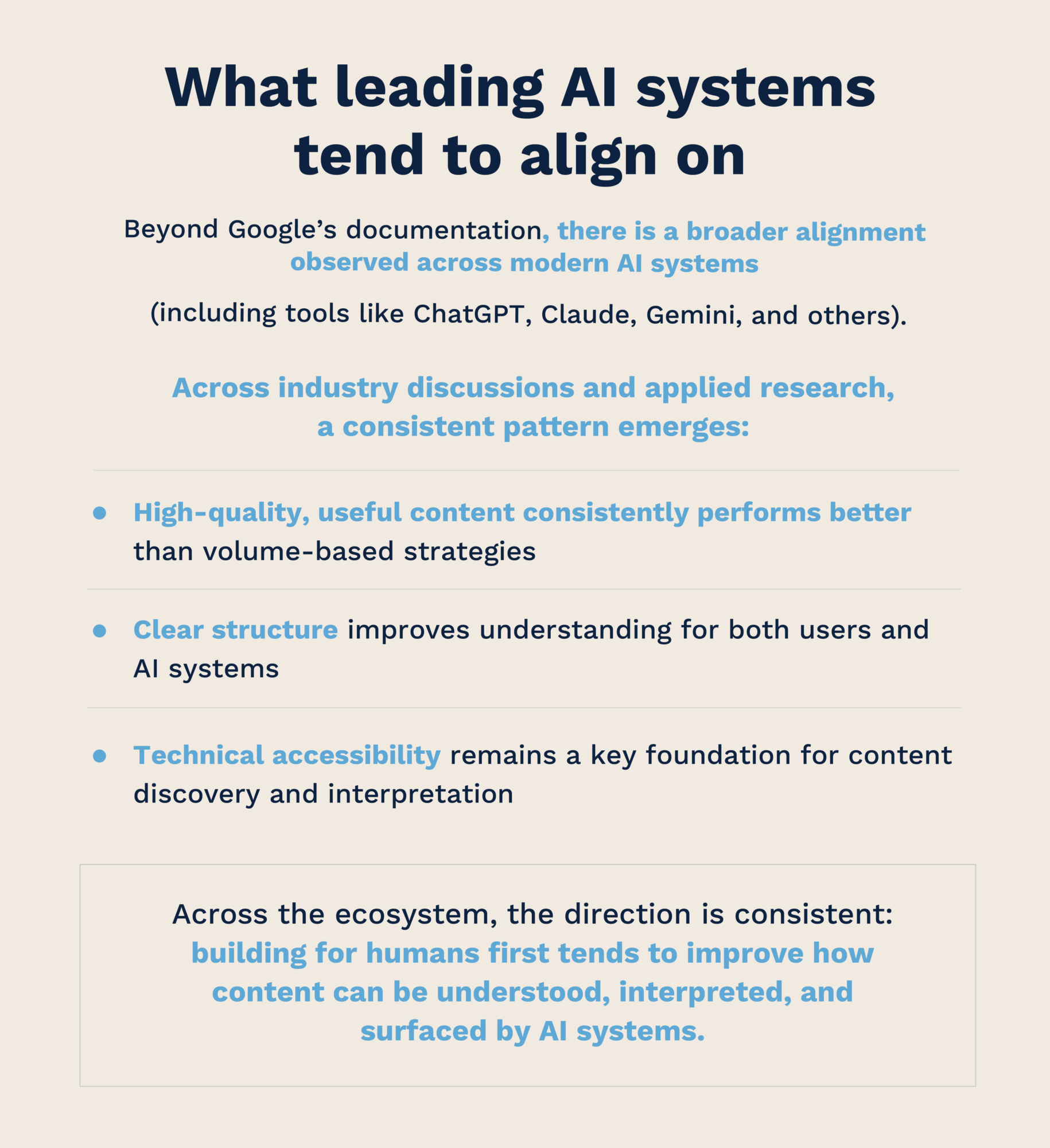
What leading AI systems tend to align on
Beyond Google’s documentation, there is a broader alignment observed across modern AI systems (including tools like ChatGPT, Claude, Gemini, and others).
Across industry discussions and applied research, a consistent pattern emerges:
- High-quality, useful content consistently performs better than volume-based strategies
- Clear structure improves understanding for both users and AI systems
- Technical accessibility remains a key foundation for content discovery and interpretation
Across the ecosystem, the direction is consistent: building for humans first tends to improve how content can be understood, interpreted, and surfaced by AI systems.